segunda-feira

All about snails - 4


Basic Land Snail Anatomy


The anatomy of a land snail is very different from many other animals in the world. Some people find them to be fascinating while others think they are pretty ugly. When you start to break down all of the parts of the body though they definitely have an interesting anatomy and physiology.


The shell of a land snail can be very different in size and shape depending on the species of snail it is. Some of them are coned while others are flatter. However, all of them have a spiral design to them, caused by the way land snails produce and growth their shells.


Shells serve as a way to protect snails from the environment and even from predators in some cases. However, many predators are able to bite through the hard shells with powerful teeth and jaws.


The shell of a land snail is made up of calcium carbonate. The shell becomes very strong and remains that way as long as the snail consumes a diet that is full of calcium. Without it the shell will start to crack. Since the rest of the body is very soft and slimy, they must have a hard shell if they are going to survive the elements in the world around them.


While moving, snails they leave behind a trail of mucus. This mucus acts as a powerful lubricant to reduce friction against the surface. This is why they are able to move upside down, around corners, and other situations.


Body parts of a land snail.


It is a myth that this mucus is going to make humans ill. Many people worry that snails being in their garden will ruin the foods grown there and make them unfit for consumption but that is all false.


They shell is a safe haven for the snails to reside in. When they sense danger around them, putting the whole body into the shell is their line of defense. You will also find that snails spend a great deal of time in their shell when the weather is very hot and dry. Otherwise their moist bodies will dry out.


Snail diagram

Image under GNU license.

Author Original by Wikimedia Commons User Al2, English captions and other edits by Jeff Dahl


Snails have one or two sets of tentacles that are on top of the head. The number of pairs will depend on the species you are describing. For species with both sets of tentacles, you will find that the eyes are present on the longer set and smell in the shorter set. You may not always see these tentacles though as all land snails have the ability to retract them.


The snail has a very small cerebral ganglion that is known to have four distinct sections on it. Although this is a rudimentary brain, they have more ability for associative thinking than most people give them credit for. Some research shows that they do take part in associative thinking, which is based on conditioning and experiences that they take part in. (1)


The mouth of a snail is found at the bottom of the head, in close proximity to the tentacles.


Most land snails have a lung, so they breathe air. To do it, they breathe through a cavity called the visceral. There are many blood vessels here and the function is the same as what our lungs are able to do for us.


There is a foot on land snails, which allow them to move forward. There is contracting and expanding in this muscle that allow them to have movement. To make this movement smoother and to avoid injuries, land snails produce mucus to help the foot slide.


Snail Anatomy Facts


Beautiful Snail Shell


A gland in the foot produces the mucus that they glide along. Without this mucus under them, the environment would be too hard for their soft bodies to move along without injury.


Covering the foot and some internal organs there is a protective layer called the mantle. In some cases, it is also found around the shell to offer it additional protection. The mantle make the shell grow by delivering the secretions that will add to the shell.


If you watch how a snail looks before moving you will notice what appear to be spasms through them and then they inch forward. These are the muscles in the foot working. Even though they do move slowly there is a rhythm to it that they will follow over and over again. This can be fascinating to watch.


(1) http://www.telegraph.co.uk/lifestyle/9433231/Germaine-Greer-Snails-deserve-our-attention.html


(2) https://insects.tamu.edu/extension/publications/epubs/eee_00026.cfm

All about snails - 3


Life cycle of a Land Snail


The life cycle of any animal is the period involving the succession of one generation to the next by means of reproduction.


The reproduction process of the snail is one that has some unique patterns when compared to that of other land animals.


In other ways though the process is the same as what you would expect. In brief, mating, gestation period, egg dropping, egg hatching, maturing period and new snails are the main stages of this cycle.


The age of sexual maturity is variable from 6 weeks to 5 years, depending on species of snail.


Land snails engage in various types of courting rituals to attract mates. They can last mating from a couple of hours to half a day.


They don’t make sounds to call out to each other like many types of animals do because snails don’t have the ability to hear. So they use touching as a way of courting. They may cover each other in mucus that they produce from their bodies before mating.


It is believed this mucus also makes it easier for them to engage in the actual mating process. Once they have done so they will go their separate directions.


What is interesting is that each snail has the reproduction organs of both sexes. Even though, snails need to mate, they do not fertilize themselves. However, after the mating, both snails are able to deliver a set of eggs.


During the mating process both snails will conceive around 100 eggs and some of species up to 400. These eggs are extremely small and they will be deposited into the moist soil and covered. It can take up to four weeks for them to emerge.


Many land snails mate regularly as long as their living conditions are adequate for survival. These eggs will be deposited in moist ground where there is plenty of shade. They are under the top layers of soil but if you dig a bit you will be able to find them.


Even with so many eggs being deposited, only a fraction of these snails make it to maturity. Many of the eggs are washed away by rain and water people use in their yards and gardens or eaten by predators.


Once born, predators also attack young snails, because they are slow, they are plentiful and their shell is not hard enough to deter the attack of some predators.


When they offspring emerge from their eggs, they immediately need to get calcium into their bodies. They are born with a shell but it is in a fragile state. The calcium will help it to quickly harden up which offers them plenty of protection. The first thing they will instinctively consume after hatching is the shell of the very egg they came from, which is rich source of calcium. The shell continues to grow with the snail over the course of its life. The part of the shell it is born will end up in the middle of it when they are fully grown.


Snails grow rings inside of the shell as they grow. This is how scientists and researchers are able to get a good idea of how old they are. For the most part it seems that snails live a life that is slow paced and very basic. You can tell if a snail is full grown or not by looking at the part of the shell that opens up to the rest of the body. If there is a small lip on it then the snail won’t grow anymore. If it is missing then the snail still will continue to get bigger.

All about Snails - 2


Interesting facts about Snails


1. Some snails Hibernate.

Some species of snails actually hibernate during the colder months of the year. They cover their bodies with a thin layer of mucus, which prevents them from drying out. Sometimes snails are also able to hibernate in the summer to survive if they are faced with a severe drought. They live off of the stored up fat during this time of year. This process is one of the many reasons why they have been able to survive for million years.


2. Snails can have a long life.

The life span for snails depends on their habitat and the species. Some of them only live for about 5 years. However, others in the wild are believed to be up to 25 years old in unusual occasions.


3. There are huge snails.

The largest land snail recorded was 12 inches long and weighed near 2 pounds. It belonged to the Giant African Land Snail species. Other species are extremely small being only a few centimeters long when they are adults and weighing just a couple of ounces.


4. Snail Moving.

While moving, snails they leave behind a trail of mucus. This mucus acts as a powerful lubricant to reduce friction against the surface. This is why they are able to move upside down, around corners, and other situations.


5. Snail Mucus.

It is a myth that this mucus is going to make humans ill. Many people worry that snails being in their garden will ruin the foods grown there and make them unfit for consumption but that is all false.


6. Living with no rush.

Garden snails (helix apersa) a top speed of 50 yards per hour, this is about 1.3 cm. per second. While they don’t move fast, they do move at a very steady pace. The snails are one of the slowest creatures on the entire Earth.


7. Snails are Hermaphrodites.Facts and information about snails

Snails have the reproductive organs of both, males and females, which categorize them as hermaphrodites. However, they cannot create offspring on their own. They must mate with another and then both of them will have the ability to lay eggs.


8. Snail can see and hear.

Most land snails have two set of tentacles, the upper one carry the eyes, while the lower one has the olfactory organs.


9. Snails are nocturnal

They are nocturnal animals, which means most of their movements take place at night.

Snails don’t like the brightness of sunlight, which is why you will find them out more on cloudy days. If you keep on in an aquarium you want to make sure that too much sunlight doesn’t filter into the room. This can cause the snail to stop eating and to spend most of its time inside of the shell.


10. Get your size.

Snails range in size from a few centimeters to 12 inches in length.


11. Snail Care.

Snails will die if you put salt on them. Make sure you don’t offer these types of items to them when you see them or when you have one in captivity because their body can´t process these items.


12. Very Hungry.

The Giant African Land Snail is known to eat more than 500 different types of plants.


13. Small, not weak.

Snails are very strong and can lift up to 10 times their own body weight in a vertical position.


14. Big family.

It is believed that there are at least 200,000 species of mollusks out there including snails. Although only 50,000 have been classified.


1. http://www.in.gov/dnr/kids/5878.htm


2. http://www.ucmp.berkeley.edu/taxa/inverts/mollusca/mollusca.php

All about snails


What do Land Snails Eat?


Snails tend to feed on a variety of items found in their natural habitat. What they will actually consume depends on where they live and the species of snail that they are. Some common items for their diet include plants, fruits, vegetables, and algae. Plants that are decaying are often a good meal for them. Seeking for calcium to get a thicker shell, snails usually will eat the dirt.


Most snail species are herbivores, which means they have only a plant diet, but some species are carnivores or omnivores. You will likely find snails around your garden as this offers them plenty of fresh plants and leaves to eat. If you use herbicides or pesticides on your plants you may be causing the death of many snails without even realizing it.


Snails as pests


Large numbers of snails though in a garden or even where farmers are growing crops can quickly become a serious problem. They will consume enough of what it growing to ruin the hard work that has been put into the area. If you are talking about a location where someone is growing food to eat or to sell then their livelihood is also being compromised. This is why people do all they can to prevent snails from consuming the agricultural crops that they are growing.


To be more humane, many that have gardens or farms strive to trap the snails that are in the vicinity rather than killing them. They either release them back into new environments or they will sell them as a source of food. Some of the easiest ways to trap them is to place lids from jars with beer in them in the garden.


For farmers that have too much land to do this, they have come up with another way to prevent damage to their crops. This involves placing 6 inch screens of copper that is placed in the ground. The slime from the snails doesn’t seem to mix very well with the copper and that means they will stay away from the foods that are growing. This process has been very successful.


Snails have to feed on foods that include large amounts of calcium. This is necessary to keep their shell hard and protective like it should be. When looking for food they use their powerful sense of smell to find their food. Snails can breathe through their skin and through an opening called the pneumostome visible on the right side of their bodies. (1) Snails have very poor vision so they can’t see what may be very close to them, but that is compensated with an excellent sense of smell.


Snails are nocturnal so they will be looking for sources of food during the night or during the very early morning hours. (2) They will consume more food at the colder months ahead come. This is so they can store up fat reserves to live on while some they hibernate during the winter.


When food sources are very low in the summer or spring months, they may voluntarily put their body into a state of hibernation as well. This allows them to conserve energy and not need to forage for additional food. This is a mechanism that allows them to be able to survive in difficult conditions of drought. (3)


They have a tongue that is very rough and the technical term for it is radula. They have rows of very small teeth that they use to scrap against the foods they want to consume. When you have snails as pets you want to pay close attention to their diet. If you feed them anything containing salt or sugar they will die.


They are often said to be very noisy eaters. However, the sounds you hear aren’t them consuming the food. Instead it is a part of the body called the radula which is tearing on what has been swallowed so it can find its way to the digestive tract.

(1)    http://www.pbs.org/kcet/shapeoflife/resources/snail.html


(2)    http://pss.uvm.edu/ppp/pubs/el14.htm


(3)    http://www.ipm.ucdavis.edu/PMG/PESTNOTES/pn7427.html

terça-feira

Empresa de Helicicultura Biojogral (Reportagem RTP2)


Uma reportagem bastante interessante acerca da constituição e do funcionamento da empresa Biojogral, dedicada à helicicultura e com uma vertente para prestação de formação nessa área.


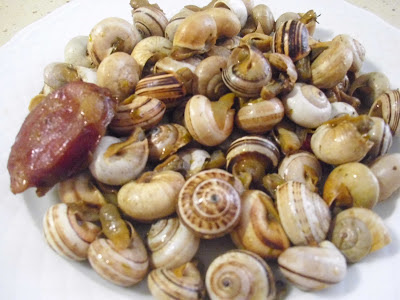
Receita de caracóis à moda cá de casa


Aviso desde já que sou muito picuinhas na preparação destes animais. 

Vou dizer como procedo para a lavagem dos bichos mas, claro está, fica ao vosso critério! 


No dia em que os compro lavo-os em várias águas para que reajam pois os caracóis "gostam" de água e retiro todos os que estejam com a casca demasiado partida e que levante dúvidas se estão vivos ou não (esses duvidosos coloco-os em cima da bancada e aguardo para ver se deitam a cabeça de fora). Se estiverem vivos, panela com eles.


Deixo-os de um dia para o outro dentro de um recipiente tapado com algo com  furos, para que não saiam, caso contrário no dia seguinte tenho que andar à procura deles!

Uso uma daquelas redes protectoras para colocar na frigideira, como a da figura.


Se preferirem podem tapar com um saco de plástico com furos, preso com um elástico.


Ou podem humedecer os bordos do recipiente e colocar sal fino a toda a volta.


No dia seguinte o processo é mais complicado e moroso.


Modo de preparação


1) Lavá-los novamente em várias águas, envolvendo-os muito bem, sem apertar para não lhes partir as cascas.


2) Ver um a um se não há algum com o orifício tapado, se estiver tapado tira-se a capa seca com ajuda do bico de uma faca e, sem água, juntar aos caracóis 2 ou 3 colheres de sopa de sal grosso e envolver durante uns minutos para que eles ao recolherem para dentro das conchas (têm "alergia" ao sal) deitem o mais possível de excreções e para que o sal ajude a limpar as excreções que estão agarradas às cascas.


3) Encher o recipiente com água e com ajuda da mão retirar a "espuma".


4) Passar por várias águas em que a última será colocando um punhado de caracóis com ambas as mãos em concha, esfregando-os muito ligeiramente uns contra os outros e com a água da torneira correndo em fio.


5) Deixe-os repousar um pouco antes de os colocar a cozinhar.


Ingredientes


  • 1 Kg de caracóis

  • 1/2 chouriço de carne aos pedaços

  • 2 cubos de caldo de carne ou de galinha

  • 1 cebola média descascada mas inteira

  • 2 dentes de alho descascados mas inteiros

  • 1 folha de louro sem o veio do meio

  • 1 malagueta

  • 2 colheres de sopa de azeite

  • 50 gr de margarina

  • 1 colher de sopa de oregãos secos

  • água q.b.

  • sal q.b.


Depois de bem lavados colocar os caracóis num tacho e cobri-los com água. Vão ao lume em temperatura mínima para que a água vá aquecendo muito lentamente, obrigando os caracóis a saírem.

Não deve aumentar a temperatura para que eles não recolham e fiquem todos com a cabeça fora das cascas.


Quando eles já não se mexem pode aumentar a temperatura do lume até que comece a ferver e ir retirando a espuma que se vai formando, com uma escumadeira ou colher.


Quando deixam de formar espuma, retiro os caracóis com a escumadeira, para um recipiente e escorro a água pelo passador de rede para cima deles, para que fique um líquido os mais limpo possível.


Volto a por tudo no tacho juntando tudo excepto os oregãos e o sal, este último deve ser adicionado logo que recomece a ferver.


Passados cerca de 20 minutos juntar os oregãos e deixar acabar de cozer, leva cerca de 45 minutos. Se achar que precisa apurar o molho deixe cozinhar um pouco com o tacho destapado quando junta os oregãos. 


A minha técnica para ter a noção quando poderei começar a provar é quando a cebola (por isso a ponho inteira) começa a ter aspecto de cozida. Normalmente o nível de cozedura da cebola corresponde ao do caracol. 


domingo

Onde comer caracóis em Leiria ? Fica a sugestão.


O calor pede petiscos e há um em particular que é daqueles que ou se ama ou se odeia. É verdade, são eles mesmo: os caracóis, petisco do pobre que com o tempo ganhou reputação de marisco.


Todo o amante de caracóis, em Leiria, conhece a churrasqueira Reis, na Cruz d’Areia. 


Doses bem servidas, caracol rechonchudo e imperial a estalar.  Estivemos lá e atestamos a qualidade do bichinho bem como do tempero. Uma verdadeira delícia!


Nesta casa só entra caracol vivo e gastam-se “à vontade” 60 quilos por semana, diz-nos a custo José Reis, o proprietário. Confiança máxima no fornecedor e receita tradicional, sem extras nem invenções são o truque, já que “não há segredo nenhum, além do facto de serem cozinhados todos os dias”, garante José.


“Os meus caracóis podem comparar-se, em termos de validade, a uma sopa. Não podem ser comparados a esses caracóis que se compram já confeccionados e que duram duas semanas no frigorífico.”


Onde comer caracóis na zona centro de Portugal


Sobre a fama da casa sabe apenas que tem contado com “o boca-a boca dos clientes satisfeitos e do serviço take-away”, já que boa parte das vendas é feita para fora, “o que acaba por ajudar a que outras pessoas fiquem a conhecer, mesmo sem vir cá”, explica.


A Churrasqueira Reis existe há 13 anos e a fama do caracol foi crescendo. Diz quem domina o assunto que “aquilo dos meses com R não é verdade” [diz-se que os caracóis só estão bons para comer nos meses sem R, ou seja de Maio a Agosto], e que “para o caracol ser bom basta haver sol, pelo que de Abril a meados de Setembro há bons caracóis”, garante José.


Mas como grande parte do caracol que comemos é importado, até se podia comer o ano inteiro. Só que os hábitos e a cultura não se mudam assim por dá cá aquela palha, pelo que caracol só com sol.


É verdade, este ano tem-nos faltado o sol e depois quem paga é o caracol.


Churrasqueira Reis
Rua Lino António, lote 53, r/c esq.
Cruz d’Areia – Leiria
Telefone: 244 802 410
Horário: segunda a sábado, das 9h30 às 2h
Encerra ao domingo
Petiscos até às 22h
Outros petiscos: moelas, pipis, pataniscas, orelha assada, chamuças, etc.